A cemetery where you can literally put “one foot in the grave.”
I’d seen the cemetery on Google Maps—lots of white rectangles—but couldn’t quite envision what was there on the ground. So my boyfriend and I planned to visit during a tour of cemeteries in the Centralia and Chehalis, WA area.
The Sticklin Greenwood Memorial Park ( Google Maps | Findagrave ) is located in the northwest side of Centralia, in a semi-industrial neighborhood that includes an elementary school, Uncle Ando’s Wurld of Weed, self-storage, and a Bavarian bed & breakfast. The large, sprawling cemetery has over 7000 graves and a troubled history, and was essentially abandoned around 2007. With the help of grants, volunteers and civic groups, the community strives to keep the grounds in good order and has even uncovered surprise graves.
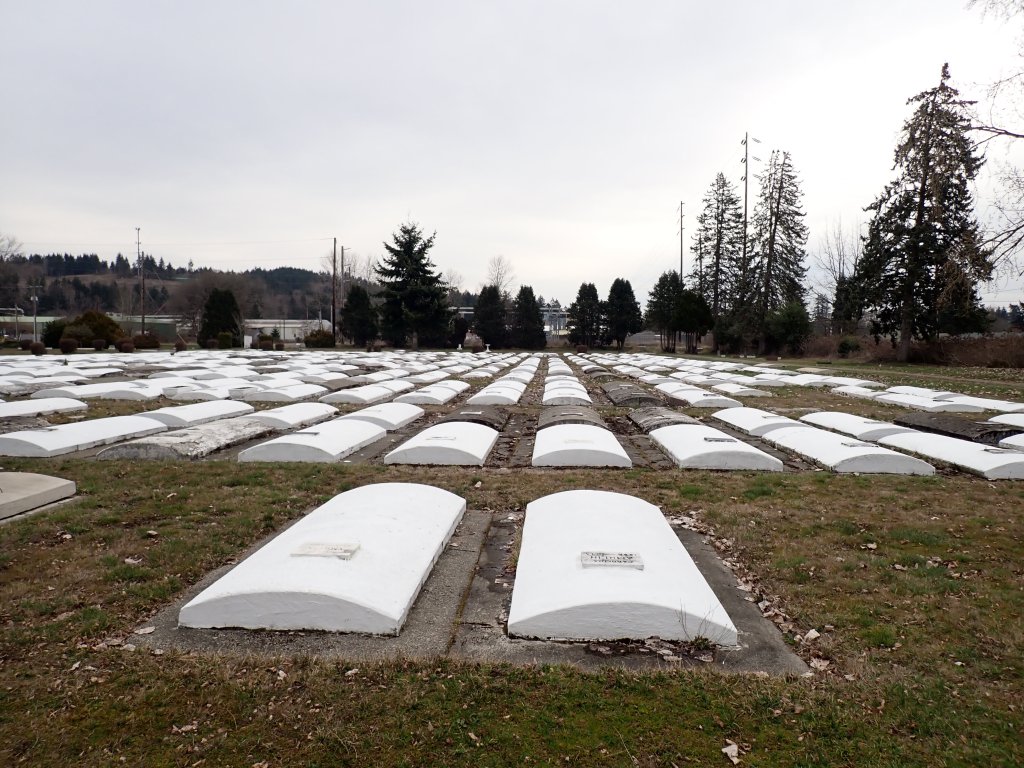
Entering the cemetery, it’s immediately apparent that the white rectangles from satellite view are concrete covers over shallow concrete receptacles. I have never seen this in any other cemetery, and I have visited over 500 of them.

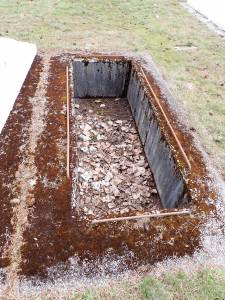
As you can see, each grave is only a couple feet deep, which would make it very easy (for a person of medium to tall height) to literally put “one foot in the grave.” It occurred to me to do this myself, and I almost did, but ended up feeling superstitious about it, so I didn’t.
I’m not an especially superstitious person, but the shallow open graves on the grounds do create an eerie impression. I can’t help but wonder if this makes the graves more susceptible to vandalism. Each of those concrete covers weighs a ton though, so it would have to be some very determined vandals.

Each concrete cover has the name, birth and death dates of its occupant. This makes for some pretty boring memorial photos on Findagrave, but I did learn that at some point the concrete covers were sealed or whitewashed or painted due to cracking and deterioration.
The shallow graves, immediately adjacent to each other, seem to me like a kind of budget burial option. It’s like they were too cheap to dig deeper and bury the vault as in other cemeteries. It makes me wonder if this was some kind of industry, cultural or community norm in the first half of the 20th century or something, or just some kind of weird economizing by the cemetery manager.
Not all of the cemetery is acres of pillowy white concrete rectangles. Some areas are much more lawn-cemetery traditional.

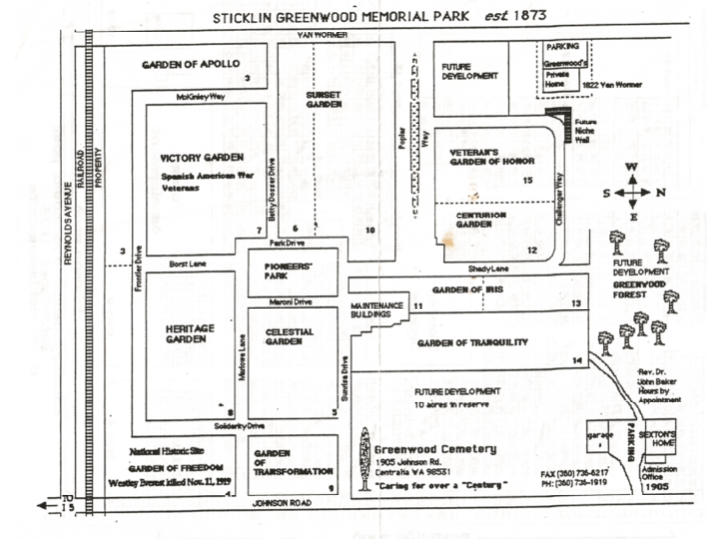
Online I found a cemetery map that plotted out areas of cemetery development such as the Victory Garden for Spanish-American War Veterans, the Celestial Garden, the Centurion Garden, Pioneers’ Park, and the Garden of Transformation. (I don’t know how the bodies buried in a Garden of Transformation would transform, and I don’t want to know.)
Despite its troubled history and somewhat unsettling appearance today, it does look like the community is making a concerted effort to bring calm and order both to residents and management. I hope they succeed. It definitely highlights the commitment that a cemetery entails.
Stump and Lamb explores personal growth and meaning via travels to pioneer cemeteries of the West.
This post was originally published at michellerau.com.
 michelle rau