“Is that my bear?”
I peeked into the window of what the facility called the “general store,” a room where residents could pick up books, hats, games, costume jewelry and whatnot. Sure enough, there was a familiar looking stuffed bear at the far end, sitting on a table. What was Mom’s bear doing in there?

The door was unlocked so I went in. I knew this bear, all right. I’d found it at a free box in the neighborhood, and was immediately drawn to its cuteness. Mom didn’t need any more stuffed bears, but I figured one more wouldn’t hurt. And if I had any doubts about the bear’s provenance, which I didn’t, I also recognized the cloisonné clay pin on its green scarf. If Mom hadn’t noticed it, someone else might have made off with it.
Yellow bear hitched a ride on Mom’s walker. We passed the front desk, and the stuffed rabbit sitting there also looked familiar! It wore a tatted hat. Yep, it was Mom’s too.
“We didn’t know where they came from,” the gal at the front desk explained. “Sometimes, things just seem to ‘go for a walk’ and they usually come back.” She whipped out a Sharpie and made notations on the critters’ butt tags.
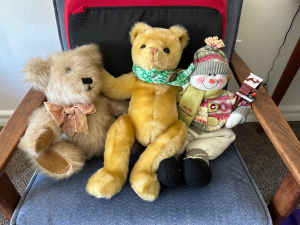
They made it back to Mom’s shelf safely. The next day, her digital photo frame “went for a walk” but was returned to her.
When Mom moved in here, we were warned that certain things might go missing, like glasses, hearing aids, canes or walkers, so it would be good to have backups. It wasn’t that people were stealing, they just borrowed things they needed even if they didn’t recognize them. Mom caught more than one person in the act of “borrowing” her walker until my brother put a large rotating pinwheel on the front of it, making it instantly recognizable.
(Whoever borrowed Mom’s walker must have been frustrated or confused — it’s a reverse-braking walker, meaning the walker stays stationary until the handles are squeezed and the brakes release. It’s the opposite of how most walker brakes work.)
The “walks” of Mom’s things might have increased when Mom moved to a room right off the lobby, near a popular activity hangout. While Mom and her roommate both have keys and can keep the door locked, they seldom remember to.
It’s hard to say if Mom is upset by her things going missing. They do usually come back. She always took very good care of her things and kept a tidy house. As her memory declines, her sentimental attachment to physical objects seems to be declining as well.

Anything I bring to her needs to be small and not valuable. I have to assume whatever I bring may “go for a walk” and may or may not come back. I don’t let this frustrate me, but I do regret the loss of control my mother now has over her living space. The usual ways of keeping treasured items safe — locking the door, putting items out of reach — don’t seem to work reliably here.
For truly special items, each resident has a locked glass cabinet outside their door, which only staff have a key to. This is a good thing, though I find it a bit unsettling. It reminds me too much of the glassed-in niches in a columbarium which contain mementos of a person’s life. (My hobby is visiting cemeteries, especially pioneer ones, so I don’t find columbarium niches unsettling by themselves — it’s the proximity of Mom’s special things to the idea that’s weird.)
Seeing my mother’s changing relationship to the things in her life has influenced me to have less attachment as well. I’m in a decluttering phase right now, transitioning both my own odds and ends, as well as Mom’s leftover items from her apartment, into a place where they’ll be useful to someone again. Whatever remains behind when I die, for the most part, I’d like it to be beautiful or useful.
Who knows, maybe I’ll still have Mom’s yellow bear.
One in a series of posts about caregiving.
 michelle rau
Leave a comment